YOU KNOW HOW TO PAINT
NOW DISCOVER HOW TO PAINT LIKE YOU
You've spent years looking outside yourself for your style when the answer may have been inside you all along.
If you've done the courses, learned the techniques and created paintings other people love, but something about your work still doesn't quite feel like yours, "Paint From the Inside Out" helps you uncover the artistic voice that's already there.
Discover the colours, marks, emotions and ideas that are uniquely yours, and create a Personal Style Brief you can take into every future painting.
"I have spent 4 years trying to find me. So many classes, so many favorite artists I admire and have copied. What you had said about “even though I get great compliments, something is lacking and it’s not me”!...I'm excited I found you!"
Cathy M, USA
Imagine being able to say in a single phrase
...Why You Paint...
What if you knew how to put enough of YOU in your work.
The colours that light you up, the marks that reflect your inner self.
Every course you've ever taken, however good, taught you to paint like the person teaching it.
That's not a criticism of the teachers. It's simply what teaching does.
The tutor shows you what they see, how they work, what they value. And you absorb it, because that's how we learn.
But absorbing someone else's way of seeing is not the same as finding your own.
Maybe you've finished a painting and felt a nagging sense that it belongs to someone else. Not that the work looks like a specific artist, necessarily. Just not to you.
There's a gap between what you put on the canvas and what's actually inside you, and no amount of technique is going to close it, because technique isn't the problem.
You've probably already tried to fix it. A new course. A different tutor. A change of subject, of medium, of palette.
And maybe those things helped for a while. Maybe the work got more accomplished. But that feeling persisted. That sense that your paintings are an echo of whoever you'd been watching most recently, rather than something that came from inside you.
find my artistic voice -$27-
Join Paint the Inside Out For $27
Get Full Access Right Away.

🔒 100% Secure 256-Bit Security Encryption

🔒 100% Secure 256-Bit Security Encryption
try it for 30 Days
Go through the process.
If it doesn't uncover something genuinely true about you as a painter that you couldn't name before, simply ask for your money back.
You either discover something valuable about yourself, or you don't pay.
WHEN you understand yourself,
your paintings become authentic.
As an artist, I was always questioning why the work didn't feel like mine...
I'd spent years:
learning from other artists
taking courses
absorbing influences
producing technically competent work
trying to understand my artistic identity
feeling a bit of an imposter
And then I developed a way through it. That way is "Paint from the Inside Out".
The difference that the Paint from the Inside Out process made to my work was incredible. Now, every time I was inspired to paint, I knew that I was searching for an inner glow that would emanate out of what I was painting. I knew what colours to reach for and why. I knew what marks I need to make and why. Instead of spending weeks researching, learning, copying and fighting with the canvas, repainting and guessing what what I could see in my mind, I was able to just paint.
To share this process with other artists who feel the same way is exactly why I created this course.
This course is created by Em Hoten, an oil painter working her way through her 'Why', exhibiting artist, and wildcard on Sky Arts Landscape Artist of the Year
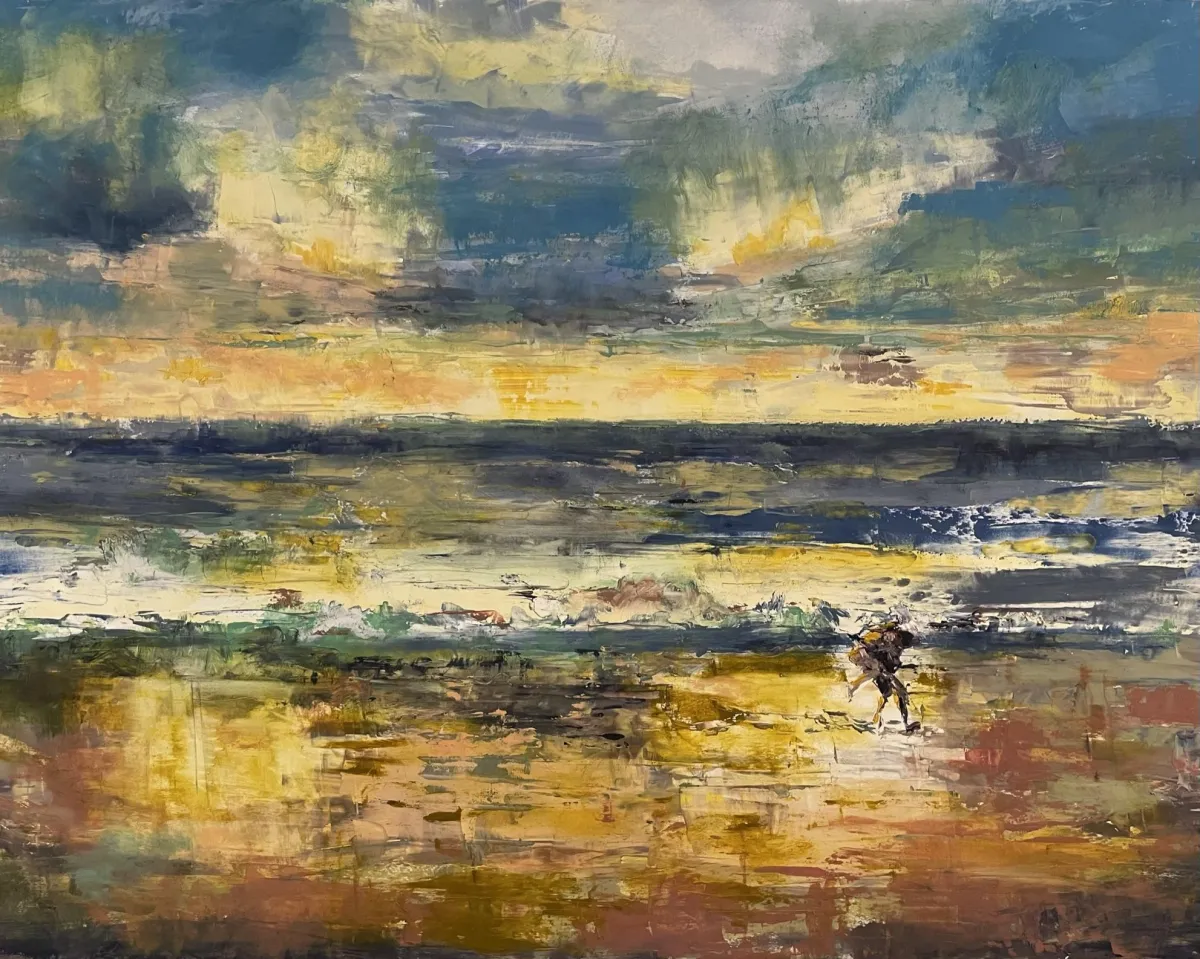
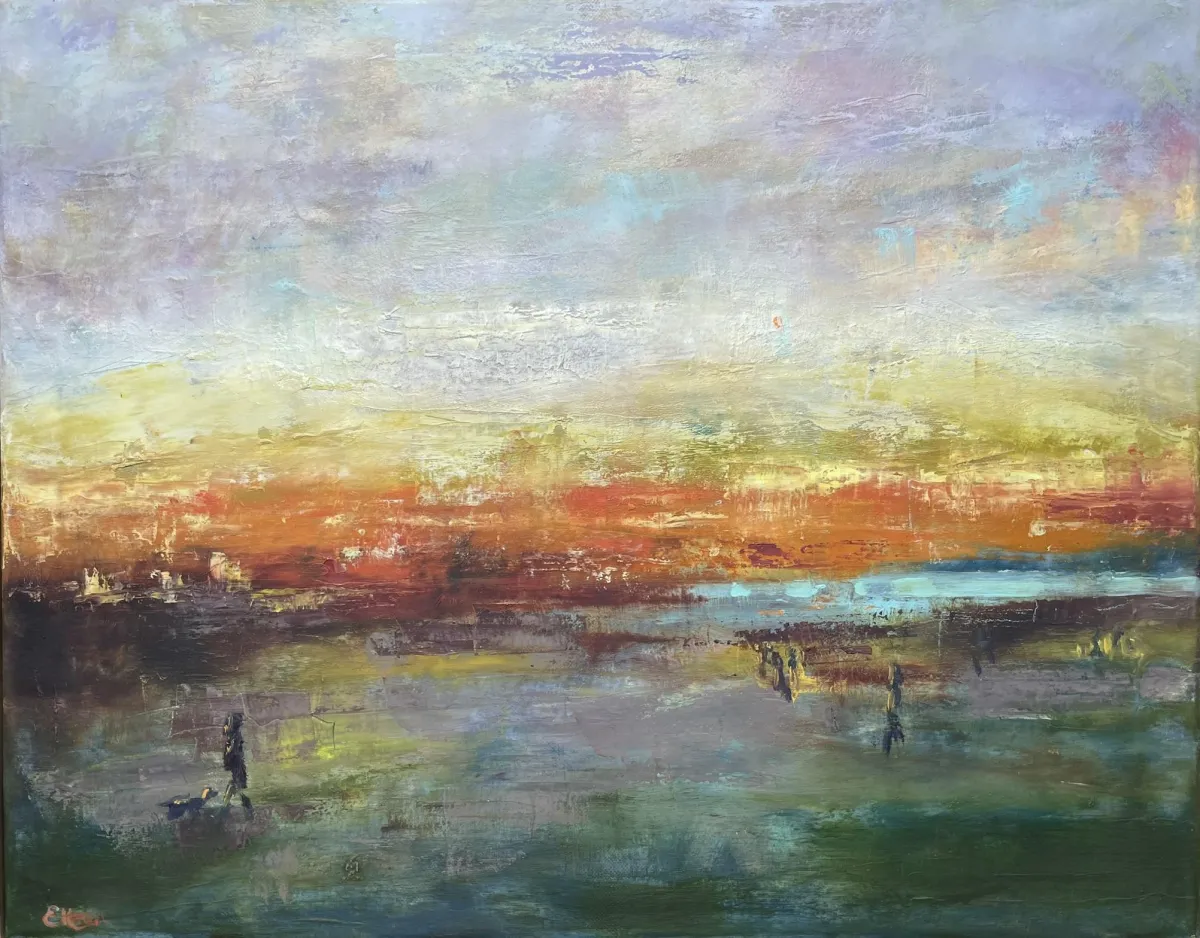
One of Em's paintings before she discovered the process.
This painting of her being given a piggy back by her dad on a beach means an awful lot to her. Full of memories and love, it was painted instinctively to express emotion
One of Em's paintings after she had worked through the process. The beach is the constant, and the memory of walking her beloved spaniels at dusk. But this painting has flashes of the unexpected in both colour and marks. It is a painting of life being lived.
"I signed up for Paint from the Inside Out after searching for my authentic artistic voice for several years. I have unlocked what is truly mine. It was there all along but I could not see it until it was mirrored back to me by Claude. I can easily say this course is one of the best investments I have made in myself and in my art.” - Myrna M, USA
Introducing Paint from the Inside Out
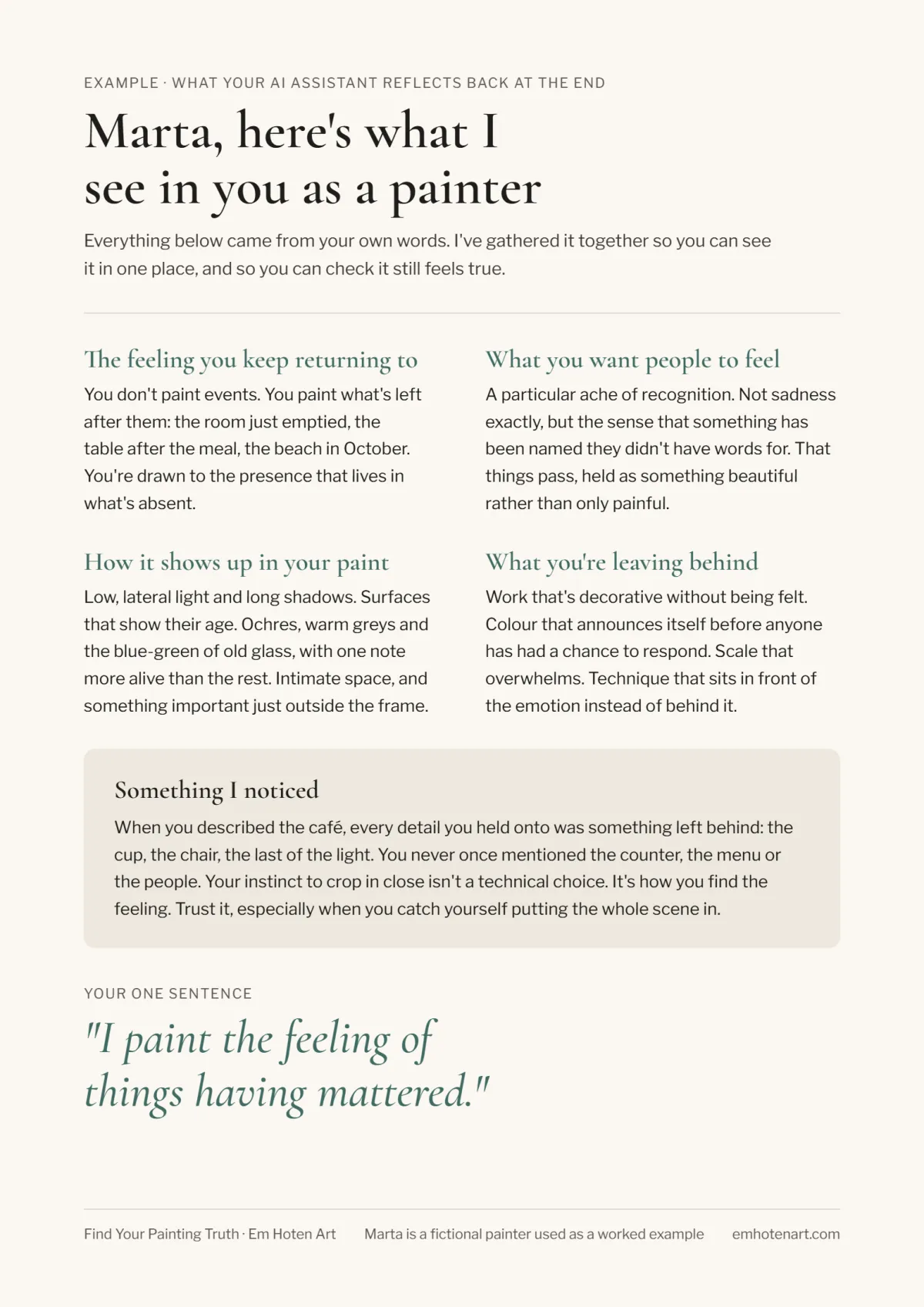
This course will give you one page to copy and print so you can refer to it again and again and gives you what no tutor can: a way to bring your own inner world into your paintings.
This is not about being given a style.
It is a course about who you actually are as a painter, what you feel, what you remember, what moves you, and how to bring all of that to the surface so that it starts showing up in your work.
It's about discovering that you already have a style, that it has always been there, waiting under the influences and the courses and the work you made for other people's approval.
The process simply helps you see it. Once you do, you can't unsee it.
And you won't paint the same way again.
One word for the feeling you want your viewer to walk away with.
Not borrowed from someone else's artist statement.
Yours, arrived at from inside your own life.
Every decision, colour, mark, subject, scale, can be tested against it before you put the brush down.
You stop hoping a painting works. You know what working means.
Your visual identity, the emotional territory you return to, the specific quality of world you want to put on canvas, has never been taught to you.
It can't be. It lives inside you.
And nobody has ever given you a proper way to get to it.
With this course you will have a reference document you can always refer to every time you enter the studio.
INCLUDED WITH YOUR ORDER
Your Identity Kit Bundle

A process built around your inner world, not someone else's
This isn't a framework borrowed from design thinking or creative coaching.
Every step, from the self-interview to the AI conversation to the style brief, was built specifically for painters just like Em was, who already know their craft and need something tutors can't give them.
Guidance at every stage, not just at the beginning
The course doesn't hand you a question bank and leave you to it.
Each module tells you what you're doing and why, what to look for, how to know when something is true rather than just plausible, and exactly what to do with it when you find it.
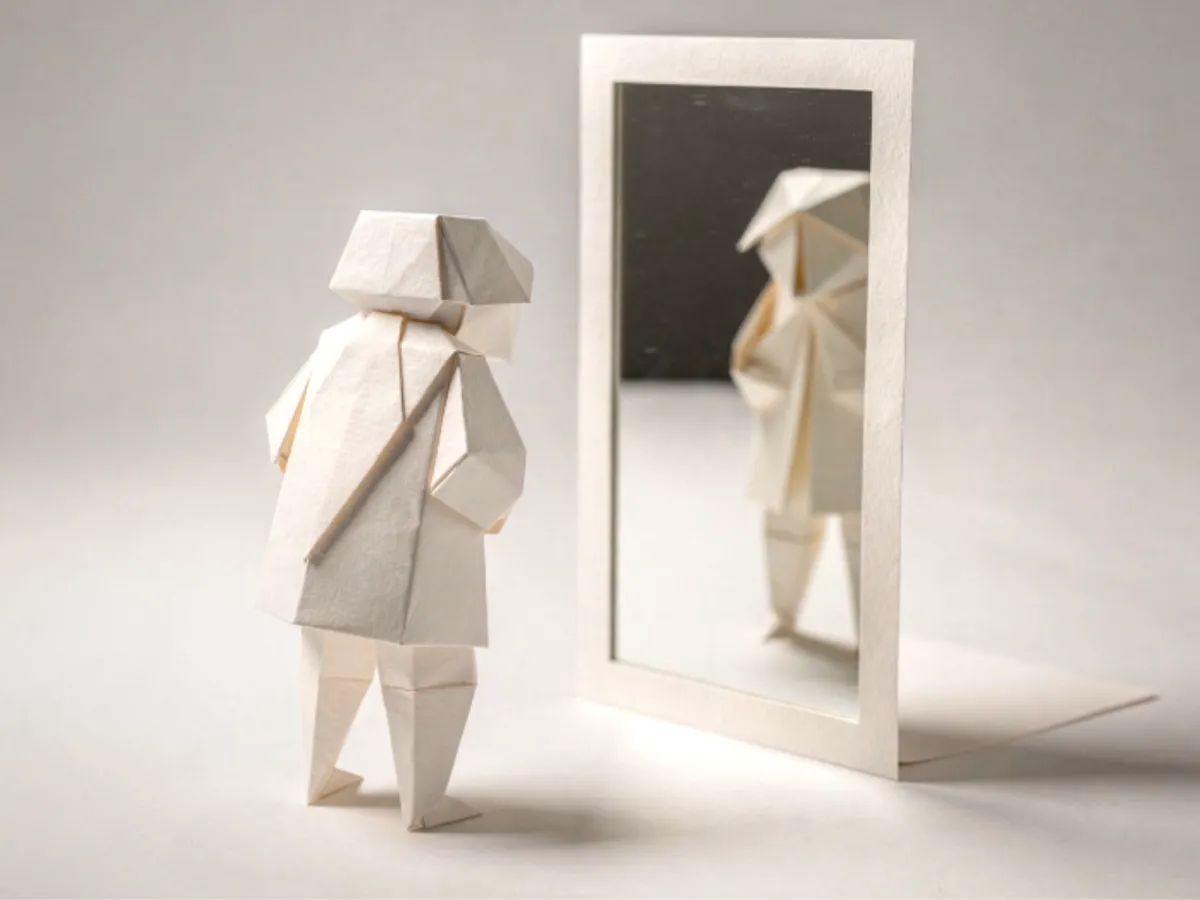
The AI does not create. It reflects,
Think of it as a mirror, not a maker.
Something you keep using long after you finish
Most courses end.
This one leaves you with your Style Brief and your Master Prompt, that you'll return to before every painting session.
They grow with you.
As your work develops, you come back and update them.
They become the thing you measure your painting against, not someone else's.
Work at your own pace, in your own time - there are no deadlines, no cohorts, no pressure to keep up with anyone else
Goes deeper than any tutor can - an AI assistant will spend as long as you need reflecting your inner world back to you, patiently and without judgement, in a way no human teacher has the time or tools to do
No prior AI experience needed - the course shows you exactly what to type, what to ask, and how to push back when the answers aren't quite right
Leaves you with something concrete - not a vague sense of direction, but two practical documents that are entirely yours and ready to use the next time you pick up a brush
THE OLD WAY
looking outward
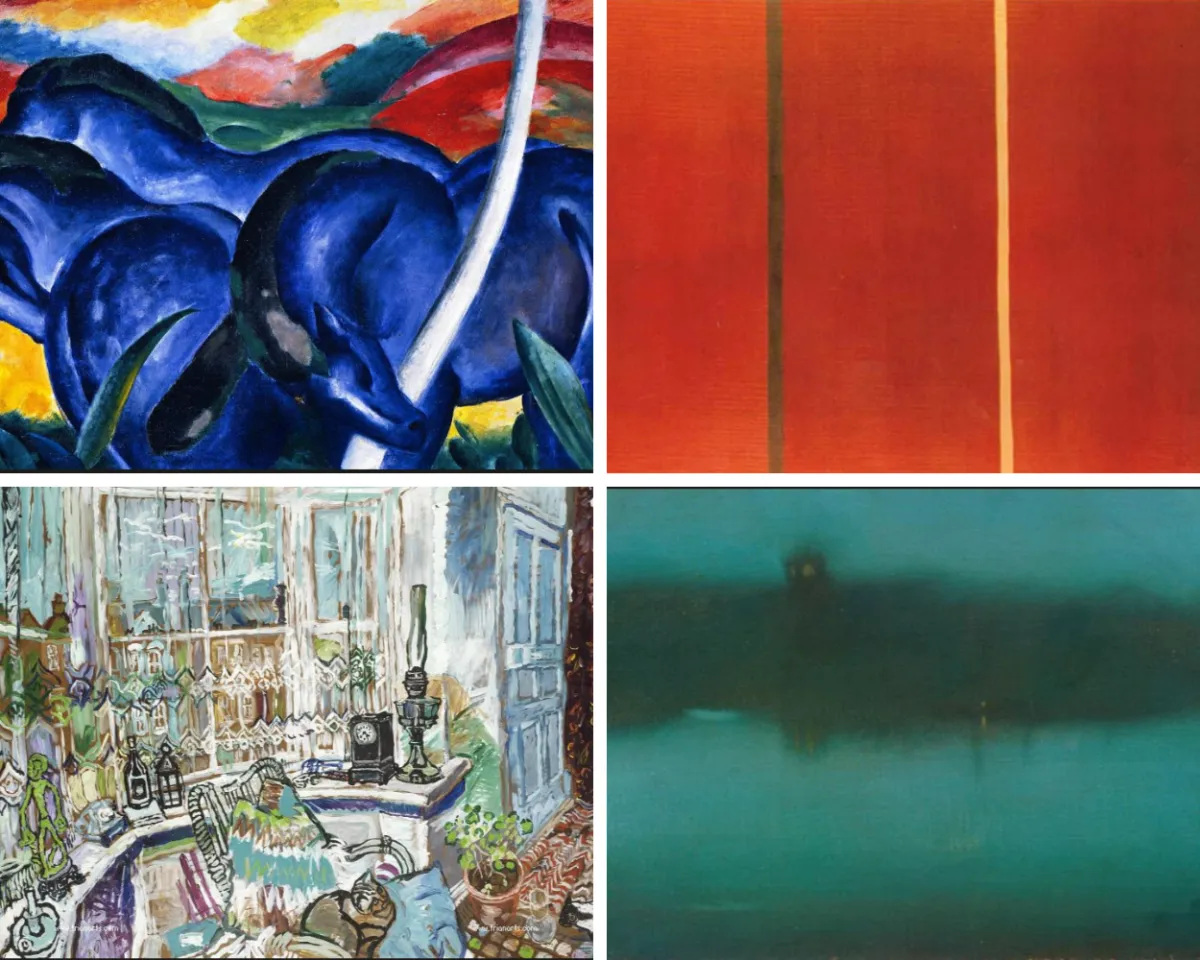
More tutorials
More techniques
More artists
More workshops
More references
More inspiration
More other people's approaches
The unintended result:
Becoming technically better while becoming less certain what is actually yours
THE NEW WAY
looking inward
Your memories
Your emotional responses
Your visual preferences
Your recurring colours
Your instinctive marks
Your sensory associations
Your reasons for painting
The result:
Recognising the patterns that were already yours.
""I've known for a while that my painting is about more than colour, marks, and layers. But this week I found the words for it. I paint for the person who has forgotten who they are beneath it all - the person buried under responsibility and expectation and the weight of being human. My work exists to remind them - and me - that the light is still there. It never left and never will." - Jo B, UK
This is what changes when the painting finally feels like yours
"I have gotten more out of it than I have in most art courses I have taken; and I have taken many. I longed to get back into my other passion of making art. So 10 years ago I began making art again. Yet I feel I do not like to speak about my art because I am unclear what my paintings are trying to say. Thank you Emma, because I have figured out what I want my art to convey and feel confident that by completing this course, I will be comfortable talking and writing words to go with my art. THIS IS HUGE for me." - Gail D, USA
There is a particular feeling that painters describe when something lands.
It is not dramatic and doesn't arrive with fanfare. It is quieter than that, and more certain. You put the brush down and you look at what you've made, and instead of that familiar hollow sense that something is missing, something is present.
Something that was not there before, or rather, something that was always there but had never made it onto the canvas until now.
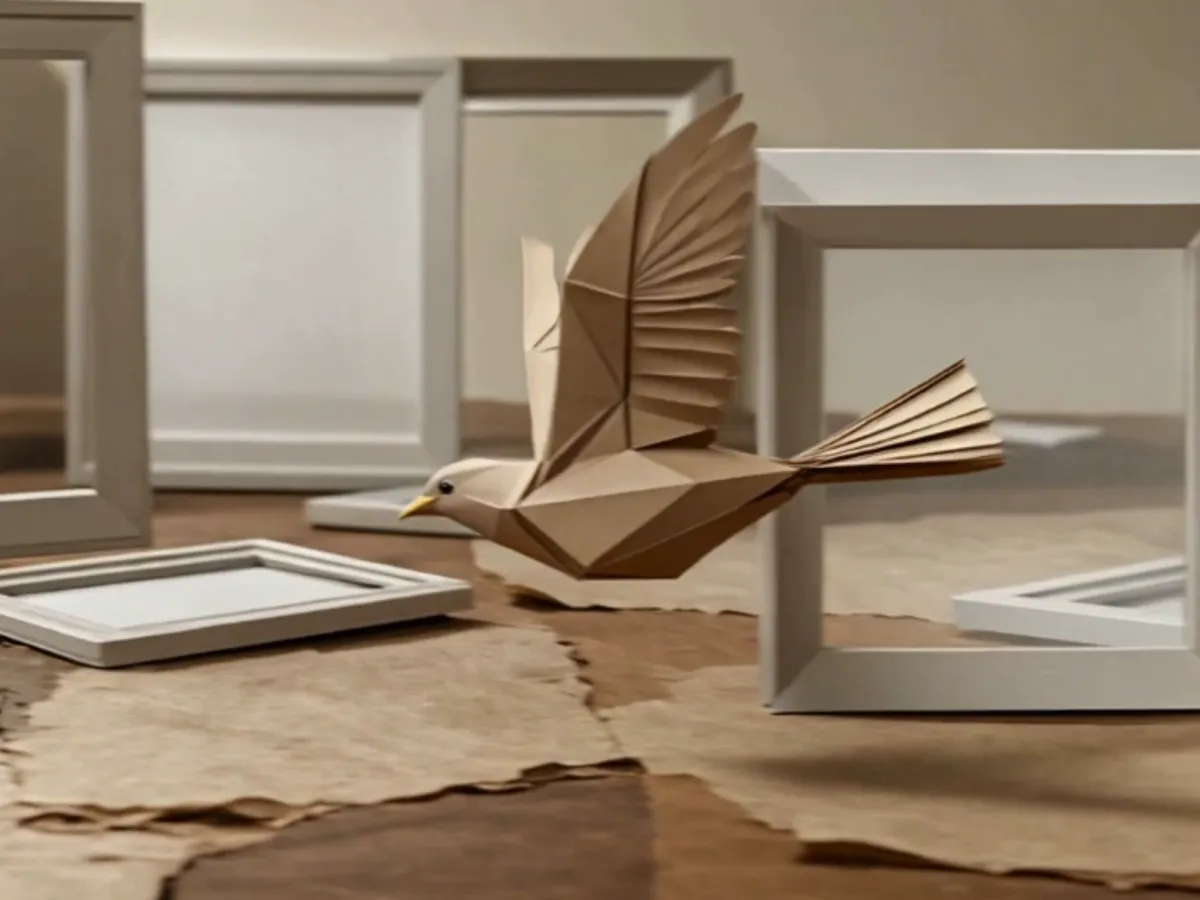
That feeling is not luck. It is not a good day in the studio.
It is what happens when the work stops coming from the outside in and starts coming from the inside out.
When what you paint is no longer an echo of the last artist you admired or the last workshop you attended, but a direct expression of your own emotional world, your own way of seeing, your own truth.
When painters reach that place, here is what they tell me changes:
They stop second-guessing their colour choices, because their palette is no longer borrowed, it belongs to them
They make decisions faster in the studio, because they have something to come back to when they feel lost
They finish paintings they actually want to show people, not because the work is more technically accomplished, but because it says something true
They stop feeling like an impostor, like someone who paints in the style of other painters rather than in a style of their own
NOW FOR ONLY $27
Join Paint the Inside Out For $27
Get Full Access Right Away.
🔒 100% Secure 256-Bit Security Encryption
try it for 30 Days
Go through the process.
If it doesn't uncover something genuinely true about you as a painter that you couldn't name before, simply ask for your money back.
You either discover something valuable about yourself, or you don't pay.
Everything You need to start uncovering your artistic identity
Paint from the Inside Out - $27
The Complete Course:
5 Modules, 12 Lessons
The process runs in a specific order, because each part does a particular job.
It begins with an honest reckoning: five paintings, one question for each. Whose work is this, really? Not blame, just clarity. You need to know where you are before you can go anywhere.
To two practical documents you'll use for the rest of your painting life
With both video lessons and downloadable pdf workbooks so you can go at your own pace.
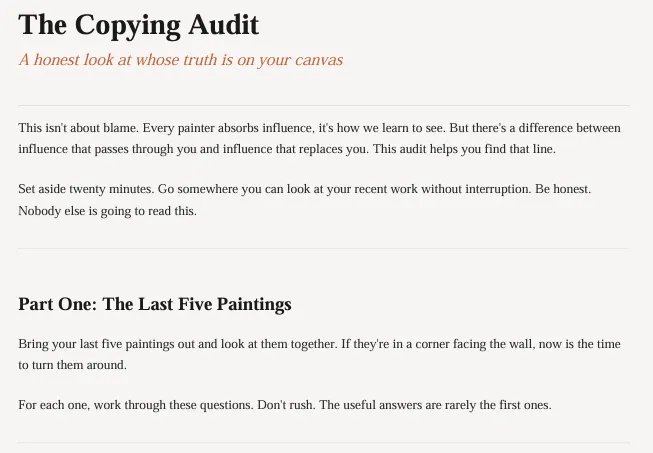
The Copying Audit
A structured exercise for looking honestly at your recent work and identifying where the influence ends and you begin
Most painters have never done this.
Most painters find it clarifying in ways they didn't expect.
The Interview Question Bank
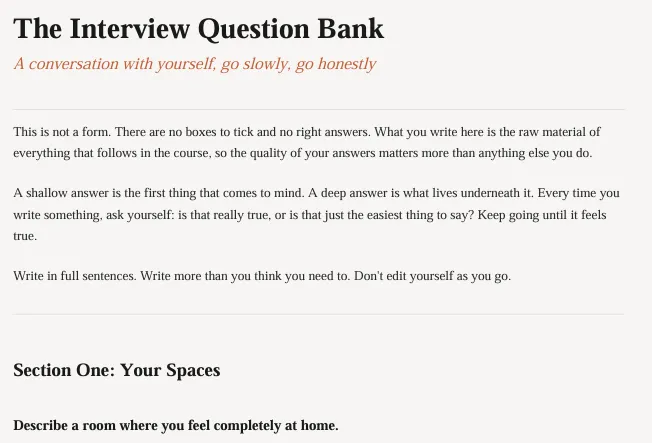
Then you go deep. The Interview Question Bank takes two hours if you're being honest (longer if something unexpected surfaces).
Questions about the places that shifted something in you, the colours you reach for when you want to feel like yourself, the textures that make your hand want to move, the memory that shows up uninvited.
Questions about your emotional world, your sensory life, your memories, and what you actually want your paintings to say.
These answers are the raw material. Everything that follows is built from them.
A downloadable PDF you can print and work through at your own pace.
The Music Experiment Guide
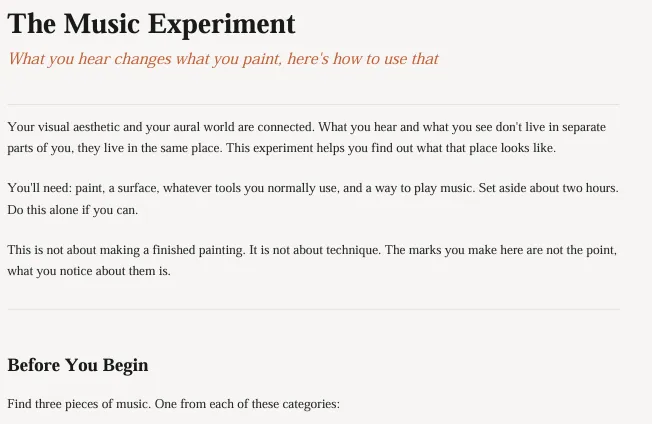
The Music Experiment does something different. You paint to three pieces of music, then look at what your hand did without asking permission.
No technique involved, that's the point. What you get is what your creative instincts look like when your thinking brain isn't in charge.
A short, practical experiment that connects your aural world to your visual instincts.
Included because it opens something up that written questions alone don't always reach
The Mood Board Brief
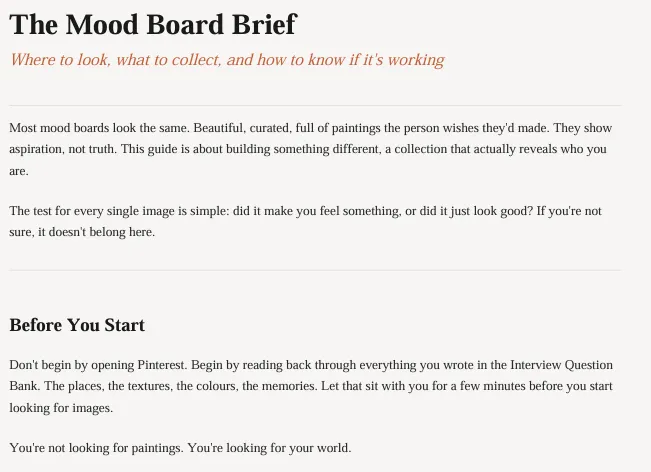
The Mood Board Brief stops you building a collection of paintings you wish you'd made. (That's what most mood boards are.)
It tells you what to collect instead, and how to know when something belongs.
You'll get clear guidance on building a visual collection that is honest rather than aspirational, including what belongs on it, what doesn't, and how to collect without second-guessing yourself.
The Image Reading Card
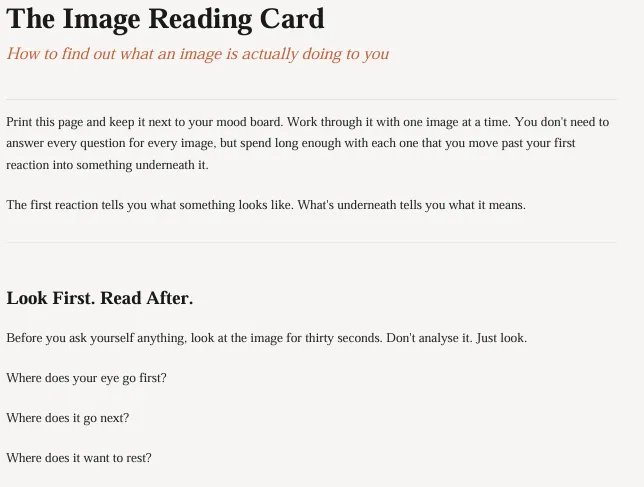
The Image Reading Card is a set of questions for reading your own reactions to images, moving past "I like this" into understanding why.
The why is what gets onto the canvas.
The Worked Style Brief Example
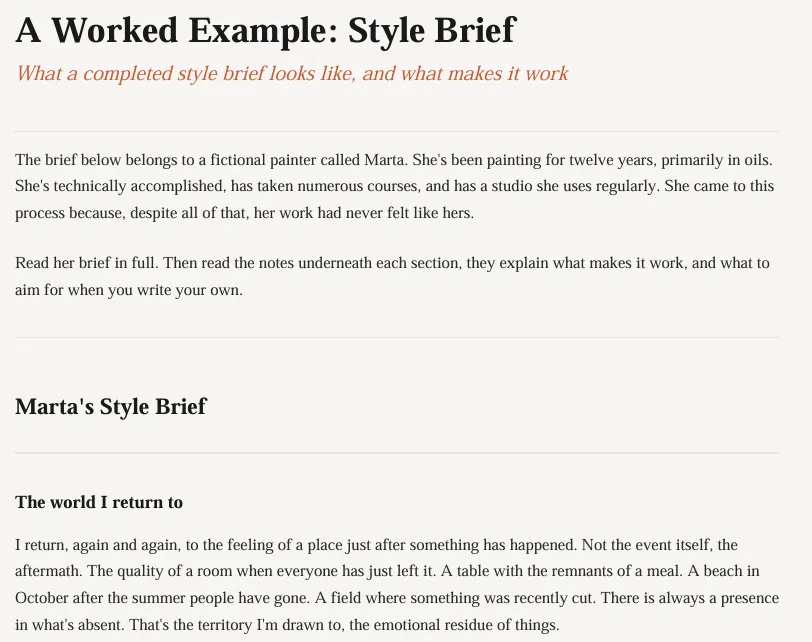
The worked example shows you what a finished brief looks like and what makes it work. Marta is fictional, but her brief couldn't belong to anyone else.
With notes on what makes each section work and what to aim for when you write your own. Read it before you write yours.
Your Style Brief will become the thing you read before you pick up a brush.
In the beginning, when you're finding your footing in this new way of working, it orients you. It reminds you what you're actually trying to do.
And because it came from inside you, from the honest answers you gave to questions nobody had asked you before, it resonates in a way that no external reference ever could
The Conversation Starter Pack
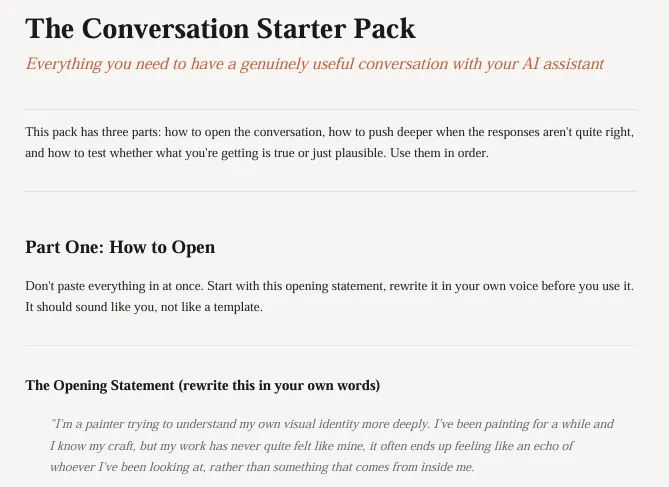
The Conversation Starter Pack opens it in the right place, pushes back when what you're hearing sounds too neat, and gives you four tests to check whether what's coming back is true or just plausible.
True feels different. You'll know.
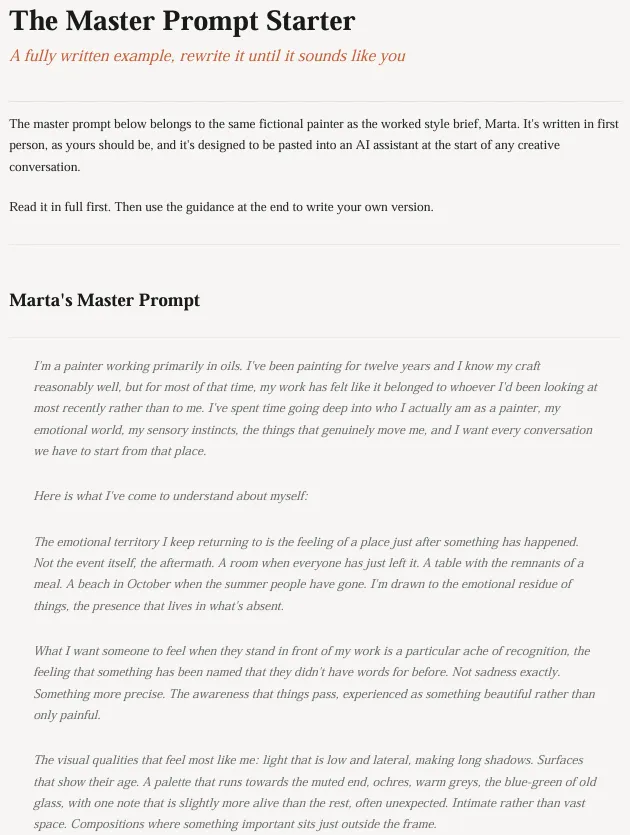
The Master Prompt Starter
The last resource is the one you build yourself. You are given a worked example to help.
The Master Prompt is what you leave with: a paragraph in your own voice, ready to paste at the start of any creative conversation from here on.
How You Use It In The Studio
The Master Prompt changes every creative conversation you have from that point on.
Instead of starting from scratch each time, explaining yourself, rebuilding context, you paste it in and you begin from a place of understanding.
Your AI assistant already knows your emotional territory, your visual language, what you're moving towards and what you're moving away from. Every conversation starts at depth rather than at the surface.
What happens in the studio changes too. Not all at once. But gradually, the gap between what you feel and what you paint begins to close.
The work starts to look like you.
Not like a you that you invented or aspired to, but like the you that was already there, waiting to show up on canvas.
Collectors who have responded to Em's work have said they can feel something specific in it, a quality they recognise and return to. That quality has a name. It is identity. And it is what this course helps you find.
This is not about becoming a different painter. It is about becoming more completely the painter you already are.
That is a simpler thing than it sounds, and a more profound one. And it starts with being willing to look inward, honestly and specifically, and trust that what you find there is worth putting on canvas.
frequently asked questions
I've never used AI. Do I need to be technical?
Not at all. The course shows you exactly what to type, step by step, at every stage where the AI is involved.
You don't need a paid account as the free versions are great for this, you don't need to understand how it works, and you don't need any prior experience with technology beyond being able to copy and paste.
If you can send an email, you can do this.
The AI is just a conversation. You talk to it like you'd talk to a thoughtful person who is genuinely trying to understand you.
The course handles everything else.
I've tried things like this before and nothing has stuck.
I hear this a lot, and I want to be honest about why this is different.
Most creative identity exercises ask you to describe your aesthetic preferences or make a mood board of work you admire. They keep everything at the surface.
This process goes somewhere different. It asks about your emotional world, your specific memories, the things that have moved you in your life, not just in your painting.
And then it uses an AI assistant to find the patterns across all of it, the things that appear again and again that you might not have noticed yourself.
What comes out of that isn't a vague direction. It's two concrete documents you can hold in your hand and use the next time you sit down to paint. That's the difference between something that feels clarifying in the moment and something that actually changes how you work.
I'm not sure my inner world is interesting enough to build a style from.
This is the most common thing I hear, and it is always, without exception, wrong.
The painters who feel this way are usually the ones whose inner world turns out to be the most specific and the most paintable, because they've been carrying it for years without ever being asked about it properly.
Your inner world doesn't need to be dramatic or unusual. It just needs to be yours. The process doesn't judge what it finds. It simply reflects it back. And what comes back is almost always more precise, more emotionally true, and more useful than anything you could have invented by trying to sound interesting.
You just have to be willing to answer the questions honestly.
Why is AI being used?
The AI is not here to make art for you.
It is not here to tell you what to paint.
It is a tool that takes the honest, specific things you share about your inner world and reflects patterns back to you that would be almost impossible to see on your own.
still on the fence?
You will know exactly what to write in your artist statements and bios
You're protected by my full money-back guarantee
Only $27
One page, in your own words,
that says what you paint and why.
Find Your Artistic Voice $27
Join Paint the Inside Out For $27
Get Full Access Right Away.
🔒 100% Secure 256-Bit Security Encryption

Copyright © 2026 | Em Hoten Art | All Rights Reserved
Privacy Policy | Terms of Service